
Spot Violence Before It Happens
Situational Awareness & Threat Detection
This course teaches participants how to recognize what is normal in their environment, identify behaviors or conditions that fall outside that baseline, and determine whether those changes may signal a developing threat. Participants then learn how to make sense of what they are seeing, anticipate how a situation may develop, and take appropriate action before it escalates.

- Establish behavioral and environmental baselines to recognize what is normal
- Identify meaningful anomalies and potential pre-incident indicators
- Recognize behavioral changes that may signal a developing concern
- Interpret observable cues in context rather than relying on a single behavior
- Anticipate how a situation may develop as conditions change
- Make informed, safety-oriented decisions and take appropriate action before a situation escalates
Recognizing a Threat Starts Before the Threat Is Obvious
Violent incidents are often described afterward as having “come out of nowhere.” In many cases, however, behavioral changes, environmental anomalies, or other pre-incident indicators were present but went unnoticed, were misunderstood, or were dismissed.
Distraction, routine, and complacency can make important changes difficult to recognize. This course teaches participants to become more deliberate observers of the people and environments around them.
The earlier a developing problem is recognized, the more options a person may have to create distance, seek help, change direction, leave an area, or take other appropriate action before the situation becomes more dangerous.
More Than “Pay Attention”
Situational awareness is not simply looking around or being more alert.
Participants learn how to establish what is normal within an environment, recognize when something does not fit that baseline, gather additional information, and determine whether the change deserves further attention.
The course emphasizes looking for patterns rather than isolated behaviors. One unusual action may mean very little. Multiple consistent cues, viewed in context, can provide a much more meaningful picture of what may be developing.
This approach helps participants avoid jumping to conclusions while still recognizing when circumstances warrant increased awareness or action.
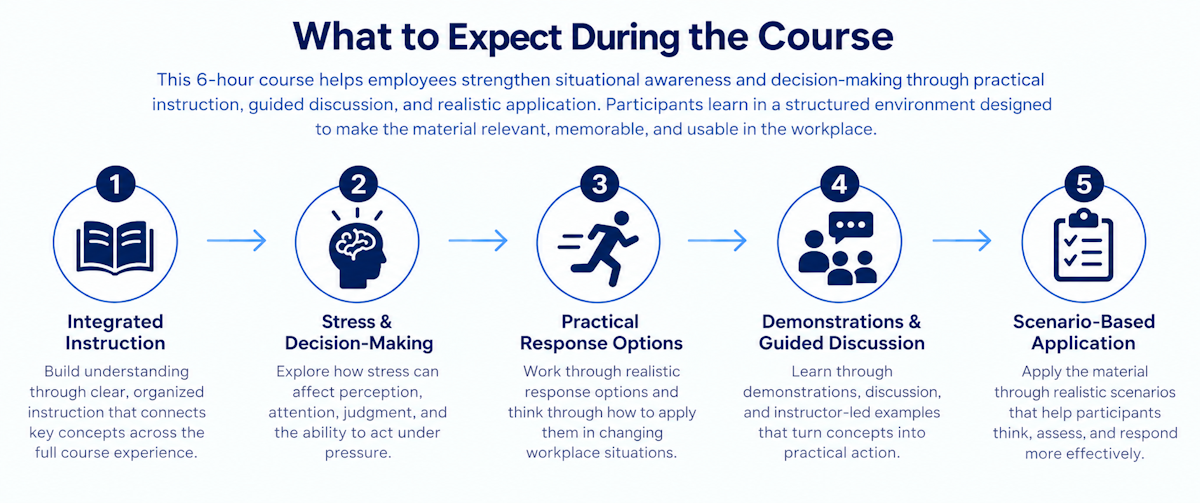
What Participants Will Learn
From Seeing to Understanding to Action
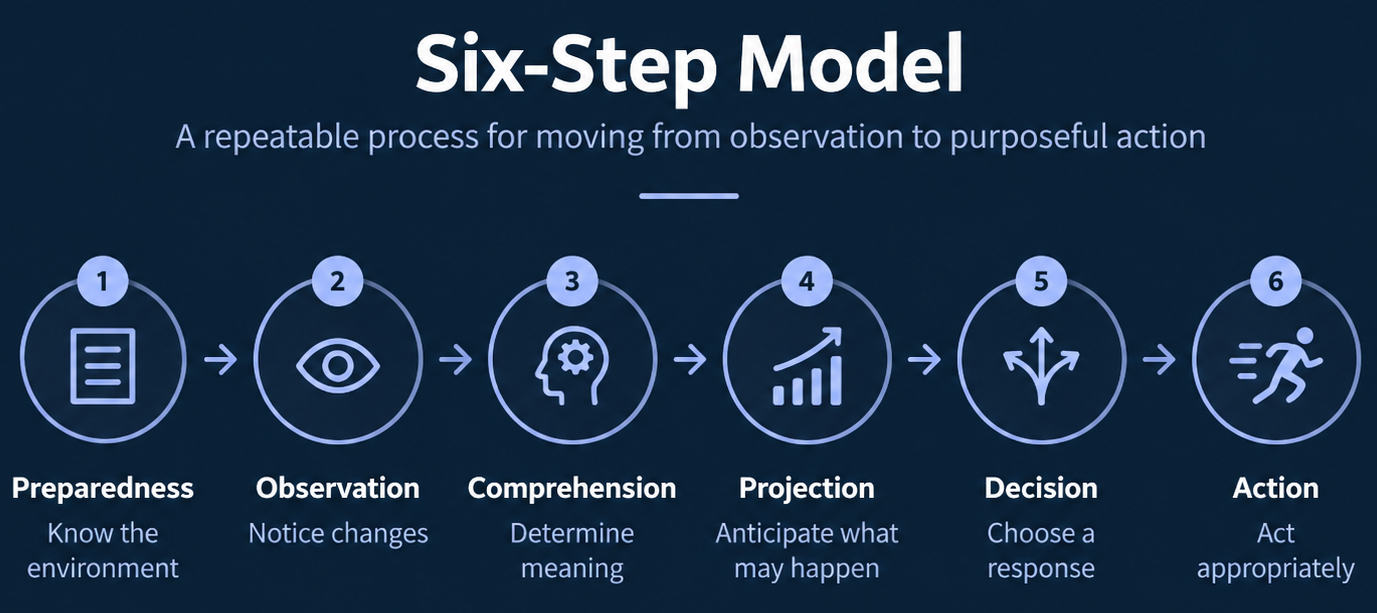
Participants learn a repeatable process for moving from passive observation to purposeful assessment and decision-making. The course develops practical skills for recognizing behavioral and environmental changes, determining what those changes may mean, and deciding when appropriate action is warranted.
- Establish behavioral and environmental baselines
- Recognize anomalies and pre-incident indicators
- Distinguish passive looking from active observation
- Identify behavioral cues associated with stress, aggression, targeting, surveillance, positioning, and possible weapon concealment
- Recognize changes in posture, movement, facial expression, breathing, tension, and other observable stress responses
- Understand how people use space, distance, and positioning
- Distinguish meaningful patterns from isolated cues and possible false positives
- Anticipate how a developing situation may change
- Make practical decisions when time is limited and information is incomplete
- Apply a structured Six-Step Model from preparedness through action
What to Look For
The Six Observation Domains
Participants learn to organize what they observe across six domains. This helps them move beyond vague impressions and evaluate behavior, stress indicators, positioning, appearance, environment, and overall atmosphere in context.
Kinesics
Body movement and behavior, including posture, gestures, facial expressions, movement patterns, and other visible actions that may provide information about a person’s emotional state or intentions.
Biometrics
Observable physiological indicators of stress, including changes in breathing, sweating, trembling, muscular tension, facial appearance, and other physical responses that may signal increased stress or emotional intensity.
Proxemics
How people use space and distance, including positioning, closing distance, grouping, movement in relation to others, and changes in personal space that may provide useful context about a developing situation.
Iconics
Clothing, symbols, tattoos, graphics, accessories, and other visible indicators that may provide useful context about identity, affiliation, interests, intent, or the situation being observed.
Geographics
How people relate to the physical environment, including entrances, exits, transition areas, blind spots, positioning, routes of movement, and how individuals use or move through a space.
Atmospherics
The overall mood and condition of an environment, including changes in noise, crowd behavior, tension, disorder, pace, and other shifts that may indicate that conditions are changing.
Course at a Glance
Delivery Options
• In-person classroom training — 6 hours
• Self-paced online course — 4 hours
• Live online seminar — 1 hour
Class Size
Up to 40 participants per instructor
Pricing
$249 per person
$149 per person
$59 per person
Group Pricing & Travel
Volume Discounts: Discounted pricing is available for larger groups.
Travel Expenses: For on-site training requiring travel, mileage, lodging, and per diem are billed separately at current federal government rates.